graph - the corpus as a knowledge graph
Point graph at a folder of mixed files and get back who and what connects,
as weighted edges with a source citation on every one. --fast does it
on-device, with no chat-model calls - a local NER model finds the
entities, co-occurrence draws the edges, and corpus data stays on the
machine, with two disclosed exceptions you configure yourself: a cloud
embed-model spends on the name fold
(entity names ride that wire), and a remote stt-model spends per clip
(audio rides that wire). First use may download the local model weights.
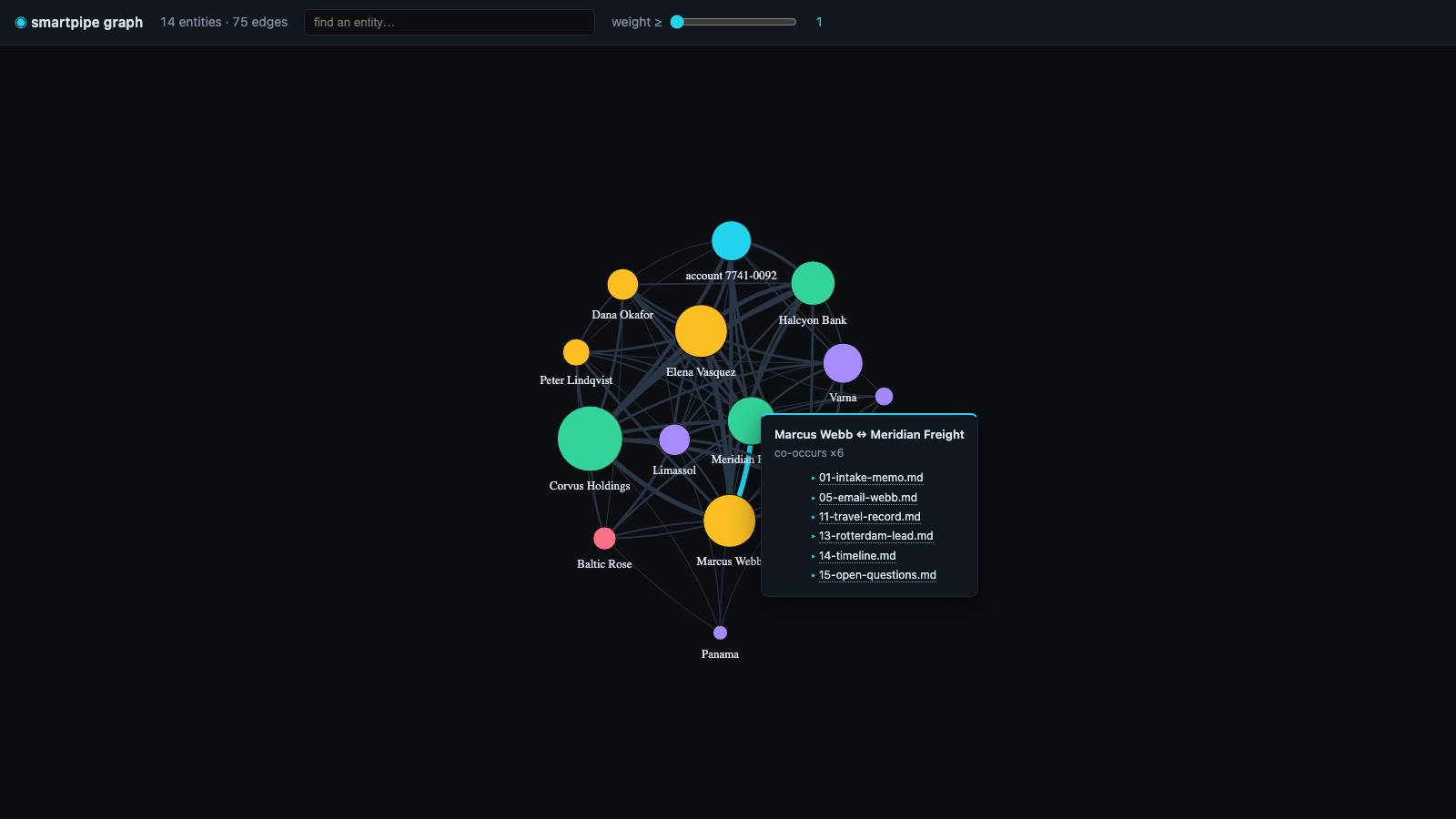
The --save case.html view of a 15-file investigation corpus - every edge
hover shows the files that back it.
The three cost forms
Free - local NER + co-occurrence, $0 by default (only a configured
cloud embed-model or remote stt-model spends, disclosed):
smartpipe graph --fast 'case/*.md' --entities "person, organization, vessel, account" --save case.html
Hybrid - the same free pass builds the graph, then one model call per edge
names the N strongest relations (N calls, no more):
smartpipe graph "who pays whom" --name-top 200 'case/*.md'
Full - a focus prompt reads everything: chunk, extract typed triples per chunk, fold (about one call per ~2k-token chunk, plus one per embedded figure - the plan prints first):
smartpipe graph "who pays whom, who controls what" 'filings/*.pdf' --max-calls 500
stdout is JSONL edges, heaviest first. This is a real edge from the corpus
in the screenshot, --fast, verbatim:
{"source":"Anatolia Star","relation":"co-occurs","target":"account 7741-0092","weight":4,"sources":[{"path":"01-intake-memo.md","as":"file"},{"path":"02-wire-log.md","as":"file"},{"path":"10-charter-draft.md","as":"file"},{"path":"13-rotterdam-lead.md","as":"file"}]}
weight counts the windows where both entities appear (--window
sentence|chunk|document sets how close "together" is); sources is the same
provenance spine every verb carries - the receipt for every claim. After the
hybrid upgrade the strongest edges trade co-occurs for a model-read relation:
{"source":"Corvus Holdings","relation":"transfers, sent, initiated","target":"Elena Vasquez","weight":8,"sources":[{"path":"01-intake-memo.md","as":"file"},{"path":"02-wire-log.md","as":"file"},{"path":"04-email-vasquez.md","as":"file"},{"path":"05-email-webb.md","as":"file"},{"path":"06-audit-note.md","as":"file"},{"path":"10-charter-draft.md","as":"file"},{"path":"14-timeline.md","as":"file"},{"path":"15-open-questions.md","as":"file"}]}
One long document? A corpus that is effectively a single window - one long
recording, one big file read whole - makes everything co-occur with
everything: a near-complete graph is window math, not signal, and the run
says so on stderr when it happens. Reach for two dials from the options
table, in this order: --window sentence first, to tighten what
"together" means, then --min-weight 2 to keep only the pairs that recur.
--min-weight 2 alone empties a one-window corpus - every pair there
co-occurs exactly once, so nothing recurs until the window is smaller.
The entity types are yours to name: the default set is "person, organization,
location", and --entities "person, vessel, account" retargets the same local
model at whatever your corpus is about - no retraining, no configuration.
Near-duplicate names (Elena Vasquez / E. Vasquez) fold onto one node, and
the fold is disclosed on stderr. Every run ends with an honest receipt:
note: graph: 21 entities (9 folded) · 75 edges (0 pruned) · 0 tok
What each modality gets
The free mode climbs only free rungs; a focus prompt unlocks the paid ladders.
Whatever can't be read is never silently dropped - it is skipped and censused
on stderr.
| Input | --fast (free ladder) |
focus prompt (full ladders) |
|---|---|---|
text, .jsonl, .csv |
read directly | chunked at ~2k tokens, one extraction call per chunk |
| PDF with a text layer | text extracted locally; embedded figures dropped (noted) | text chunks, plus one vision call per embedded figure |
| scanned PDF, images | skipped and censused | read by the vision model (or --ocr-model at ingestion) |
| audio | transcribed locally with whisper — or through --stt-model/the configured role (a paid wire is disclosed) |
10-minute slices ride the audio ladder - native where the model hears |
| video | audio track transcribed locally (or via --stt-model); no track = skipped |
10-minute slices - native video where the wire watches, else frames + transcript |
The census is one line, with the fix inside:
note: 30 files skipped — no free text (images/scans); the full mode or ocr-model reads them
A live Mermaid graph
--save graph.mmd writes a Mermaid diagram. This one is real output -
graph --fast over the same 15-file corpus, --top 6:
graph LR
  n0["Anatolia Star (10)"]
  n1["Corvus Holdings (12)"]
  n2["Elena Vasquez (10)"]
  n3["Halcyon Bank (8)"]
  n4["Marcus Webb (10)"]
  n5["Meridian Freight (9)"]
  n1 ---|8| n2
  n1 ---|8| n4
  n2 ---|8| n4
  n0 ---|7| n1
  n0 ---|7| n5
  n1 ---|7| n3
  n2 ---|7| n3
  n0 ---|6| n2
  n0 ---|6| n4
  n1 ---|6| n5
  n2 ---|6| n5
  n3 ---|6| n4
  n4 ---|6| n5
  n0 ---|4| n3
  n3 ---|4| n5
Mermaid chokes on big graphs, so the export keeps the biggest hubs (40 by default) and says so:
note: mermaid capped to the 6 biggest hubs of 12 nodes — --top adjusts it
--save: six formats
The extension names the format; a typo refuses before any work is done.
--save |
Format | What you get |
|---|---|---|
graph.html |
interactive view | one self-contained page: search, a live weight filter, hover provenance cards (the screenshot above). Data embedded; only the renderer loads from a CDN, disclosed in the file header |
graph.graphml |
GraphML | opens in Gephi and yEd, attributes included |
graph.dot / .gv |
Graphviz | weights become pen widths; render with neato |
graph.mmd / .mermaid |
Mermaid | paste into any Markdown that renders mermaid fences |
graph.csv |
CSV pair | writes graph.nodes.csv + graph.edges.csv, importable into Neo4j or Kuzu |
vault/ (trailing slash) |
Obsidian vault | one note per entity with wikilinks to its neighbors, citations per edge, and an index.md ranked by mentions - open the folder in Obsidian and use its graph view |
--top N caps the display formats (dot, mmd, html) to the N biggest
hubs; the data formats (graphml, csv, the vault) always carry the complete
graph. --min-weight N drops edges below N co-occurrences everywhere.
The preflight plan and the belt
The full mode never spends blind. The cost plan prints before the first call:
note: ~15 extraction calls across 15 files; belt is 5 — the graph will be partial
At a terminal, a belt smaller than the need asks before spending:
proceed with a partial graph? [y/N]
If you proceed (or stdin is a pipe, where nothing can ask), the run drains at the cap into a disclosed partial graph - and never pretends it finished:
note: belt hit — 5 of 15 chunks extracted; the graph is partial (rerun raises the belt; cache makes it cheap)
A belted run exits 1, not 0, so scripts can tell. Rerunning with a higher
--max-calls is cheap: cached extractions are free.
The hybrid mode degrades even more gently - edges the belt could not name
simply keep co-occurs, disclosed:
note: named 4 of 5 (belt); 1 strongest remain co-occurs
Weak machines
The free pass is CPU work (a one-time ~190 MB model download, then local inference). On a slow machine, preview on a seeded sample first - same pipeline, two hundred rows:
smartpipe sample 200 < corpus.jsonl | smartpipe graph --fast
Long runs project their own duration after the first twenty windows and say
so once on stderr; Ctrl-C is safe.
Adopt your own edges
Edge-shaped records on stdin skip extraction entirely - graph folds,
canonicalizes, and serializes them for free. Both {"source", "target"}
(graph's own output shape) and {"subject", "relation", "object"} rows work,
and weight and sources are carried through:
cat edges.jsonl | smartpipe graph --save deals.graphml
This is the power path after a custom extend extraction, and it
means graph output can be filtered with jq or where and re-serialized
without re-reading the corpus.
Options
| Flag | Meaning |
|---|---|
--fast |
the free mode: local NER + co-occurrence, on-device (a cloud embed-model or remote stt-model spends, disclosed) |
--entities "a, b" |
entity types to find (default "person, organization, location"); with a focus prompt they become the subject/object type enum |
--relations "pays, owns" |
closed relation vocabulary for the model-read modes (typed ontology) |
--name-top N |
hybrid mode: free pass, then one naming call per edge for the N strongest (repair retries and the fold's embedding calls also count against --max-calls) |
--window sentence\|chunk\|document |
how close "together" is (default chunk) |
--min-weight N |
drop edges co-occurring fewer than N times |
--save PATH |
also write .graphml/.dot/.mmd/.csv/.html, or a directory/ for an Obsidian vault |
--top N |
cap display formats to the N biggest hubs |
--model, --concurrency, --max-calls |
the usual model dials for the paid modes |
--stt-model MODEL |
scanning modes (--fast/--name-top): transcribe audio/video through the stt-model role — openai/whisper-1 spends per clip (disclosed once per run), local pins free on-device whisper; refused elsewhere |
--ocr-model MODEL |
full mode: parse scanned PDFs/images at ingestion (each use disclosed) |
FILES…, --from-files, --as |
the usual file inputs |
See also
- A knowledge graph from a mixed corpus - the full recipe on the playground corpus
extendfor custom edge extraction ·splitfor the chunking units the full mode reuses ·clusterwhen you want themes, not entities